

City Limits
Or How Dark City May Be Better Than The Matrix

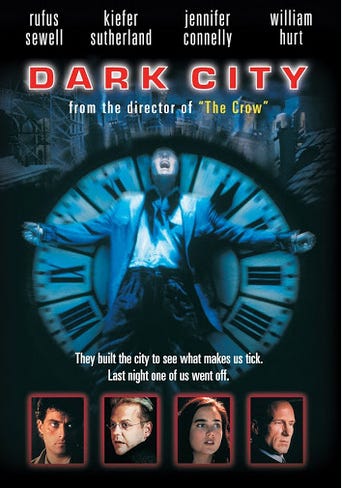
Medium Spoilers for 1998’s Dark City Ahead
In the late 1990s, a film came out unlike any other. A confused young man lived in a nameless city that he found out was built on a lie. He’s initiated into deeper understanding and power by a mysterious and cryptic mentor figure. He’s opposed by the city’s jailers while themselves trapped by the thing they built to keep humans under lock and key.
I ask you, dear Guests...if I were to say this without any hints upfront, would you think I was talking about anything other than The Matrix? Mind, that description does fit with it. However there is one other film that matches with it that came out the previous year. It even used some of the same sets (pay particular attention to the rooftops and bottom of the stairwell). It was a strange, surreal cult film that grounded its look and plot in early 20th Century German Expressionism. And as with all subjects we discuss in the Palace, it deserves to be better-known.
So...tonight, I present you with one of the oddest 1990s films not directed by David Lynch: Dark City, directed by Alex Proyas. It was also written by him with David S Goyer and Lem Dobbs.
One brief note first: I’m basing this review on the excellent Directors Cut my mom gave me as a Christmas present. But even before that, I watched this film obsessively during an unhappy period of my life. So I will be pointing out a few differences between this and the theatrical cut where appropriate.
Right, onward...
The Curtain Of Night Rises
The opening of Dark City is easily the biggest change between theatrical and director’s cuts. In the former, a raspy voice (spoken by Kiefer Sutherland) intones a long monologue that basically gives away two-thirds of the film’s surprises.
So...because I am anti-spoiler as a rule, here’s another recommendation if you’re watching the theatrical: mute that part. Wait until the watch is pulled out. Okay, here’s the director’s version…
We open on a vast starscape before the camera begins panning down. It goes for a long way before it run through a bank of clouds, then a cityscape at night (heavily inspired by Fritz Lang’s Metropolis). This setup makes me think Proyas got the idea for this shot from Orson Welles’ Citizen Kane.
We finally settle on Sutherland’s character, who’s wearing a plain brown suit that looks early 20th Century. He walks with a limp and the right side of his face is mildly deformed. He glances at his pocketwatch, ticking ever closer to midnight. When the second hand finally hits the twelve mark, the watch stops cold. He gives a weird grin while putting the watch away and limping off into the darkness.
After some brief opening credits, we shift to outside a multi-story hotel before the camera pushes into the nearest bathroom. An unconscious man (played by Rufus Sewell) is laying in the bathtub while the overhead light swings back and forth.
He comes to with a start. Once he gets out, he slips and slides his way across the forest green tile to the fogged-up mirror. It’s clear he’s got no more an idea of how he wound up here than we do. After getting on his clothes, he finds an old postcard from somewhere called Shell Beach. That triggers some vague wisps of memory that get interrupted when the room phone rings.
Our twisted man is on the other end. He’s talking a mile a minute and not making a hell of a lot of sense. He calls himself a doctor, pointing out our mystery bather has lost his memories due to an experiment. Oh and somebody’s coming our mystery man needs to avoid...like, now.
Mystery Man drops the phone when he sees something on the side of the bed. Specifically, a dead female body with bloody spirals carved on the bare chest. That gives him the incentive to GTFO and just in time too. A trio of pale, trenchcoated figures—small, medium and large (I swear I’m not making that up)—get off the elevator just as he hits the stairs.
Once Mystery Man gets to the lobby, he finds literally everybody around him asleep. This includes a woman in a phone booth, still cradling the receiver. There’s a sudden flicker of lights just when everyone wakes up, including the desk clerk (played by Edward Grant). The latter calls Mystery Man “Mr Murdoch” and advises him that his wallet is at the Automat (a restaurant where meals are served through a vending machine...did I mention the first one was in 1895 Berlin?).
While Murdoch goes to retrieve his lost property, the clerk goes up to his room. Too bad for him the trio from before are still there. The shortest one (played by legendary writer/actor Richard O’Brien) asks a simple, sinister question: “Mr Murdoch, yes?” After confirming Murdoch’s gone, Short Ghoul puts the clerk to sleep with a command.
We cut to a nightclub, where a singer (played by Jennifer Connelly) is singing to the crowd (polished vocals in the theatrical version, a bit off-key in the director’s cut...there’s a reason for the latter BTW). After the performance, a coworker hands her a card for a Dr Daniel Paul Schreber, saying it’s about her husband.
Turns out Schreber is our twisted man from the beginning, now sporting a mad scientist coat from the Dr Frankenstein collection. While he performs a self-confessed “crude experiment” involving rats in a maze, he probes our singer Emma Murdoch on her husband John’s whereabouts. She knows nothing, including the fact that her hubby was even seeing this freak.
Schreber gives her a story about how John has been his patient, stemming from their “marital difficulties”. He lets her go but asks her to keep him apprised. He doesn’t even show her out. He’s too busy playing with his rats.
Our final major player enters to the gentle sound of accordion music. He plays the instrument next to the window when it’s interrupted by a phone call that annoys him. Turns out he’s Inspector Bumstead and he’s caught the case of the dead body at the hotel. It’s far from the first. She’s simply the latest victim in a string of serial killings involving call girls.
Oh and Bumstead wasn’t the first guy on this case either. His predecessor Eddie Walenski (played by Colin Friels) bursts in. His babbling makes Schreber’s earlier phone call sound like a news report. Walenski keeps yelling about there’s no way out and how “they’re” watching us. His disorder is a match for his old office, overflowing with junk and files and less sanitary things.
So...confused yet? Perfectly understandable, dear Guests. All of what I describe is likely why the theatrical cut included that spoiler-heavy monologue. But I can promise this...every question you have right now is answered before the film’s end. And that is all I shall say in terms of major features of the plot.
Personally, I think our time would be better spent dealing with our major players. Beginning with Mr. Murdoch.
The Blanked Slate
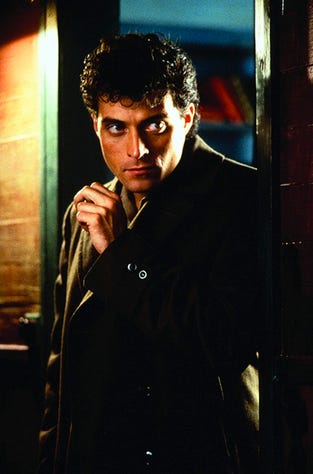
As should be obvious, John Murdoch is pretty much a total amnesiac. Despite a few fleeting memories, he’s pretty much in the same position we are for the whole film. He roams the warped streets (taking their cue from Cabinet Of Dr Calagari) for answers. His only clues are his few possessions and what he can deduce from them.
His particular obsession is Shell Beach, the one thing he can remember. He constantly asks people how to get there. Everybody’s heard of it but not one of them can point the way. Even the train line, which promises a route, only has an “Express” that nobody seems to be able to get on.
One can hardly blame John for wanting to get out of this city. Its own quirks shows it’s anything but a safe place. For one thing, there’s never any daylight here. For another, every twelve hours, the entire population goes to sleep...except for him.
Lucky him, John gets to stay awake while the buildings and streets reshape themselves in an unnerving, organic fashion. The people get changed too. They’re put in new places, given new clothes and given forehead injections that look very painful.
Small wonder why this all stresses him out. When the stress gets too much, he exhibits an odd form of telekinesis called “Tuning” by his pursuers. He can use it to widen cracks in a floor, push around objects with his mind, even make doors appear on previously blank walls. Tellingly, the beings going after him are every bit as shocked as he is on how he can do this.
In some ways, John’s like an actor who didn’t get his script. Newspaper clippings have him pegged as a mass murderer. But it’s anything but the truth. What lies under that truth? That it’s easier to go with the flow instead of finding your own way.
Even without telekinesis, that truth makes John Murdoch the most dangerous man in this city. But it also makes him very lost and alone. How many of us who have gone against the grain have been there?
The Frustrated Seeker
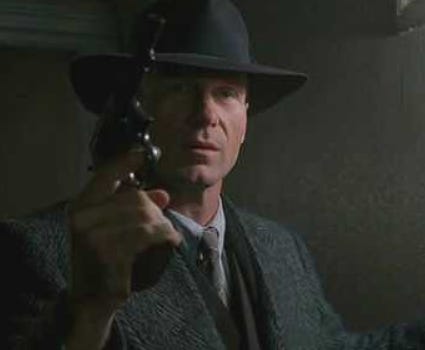
When it comes to a thirst for answers, Inspector Bumstead is actually very similar to John. There is one key difference. Bumstead’s already inside the script his unseen jailers have laid out.
He does his best to work within the structural confines but it keeps getting him nowhere. As he tells Emma, “No one ever listens to me.” At one point, he goes deeper into his frustration while yelling at John:
“I have this jigsaw puzzle but every time I put the pieces together, it still doesn’t make sense!”
The pieces he has to work with are some doozies, the kind that don’t fit with the reality he’s being told. He finds them in Walenski’s ravings, Schraber’s too cute answers to his questions, odd tics he sees in Anna’s behavior. Even his own memories of his accordion make him suspicious. He got it from his late mother...yet can’t remember any of the details on how that happened.
All this finally pushes Bumstead to help John. He knows the truth is out there. And that the only way it’s coming is if he takes extreme steps. It ends in a good news/bad news situation. The good news is he finds what he’s looking for. The bad? Finding it has him suffer a very ugly fate.
Too many folks lean hard on the saw “the truth will set you free.” To me, Bumstead’s arc speaks of what that “freedom” can cost you. Sometimes, it’s more than the seeker can possibly imagine.
The Deformed Doctor
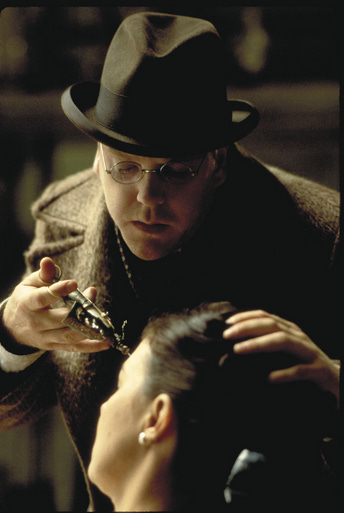
Dr Daniel Paul Schreber occupies a privileged position in the city’s hidden hierarchy. Just as the Strangers (as he calls the city’s hidden overlords) remix the city layouts, so he remixes the citizenry’s memories where appropriate. He even gets a little joy from his random combinations and sending those into their skulls.
That said, none of this changes certain facts. Like how he’s just a skilled, useful slave to the Strangers. How his existence only continues by their sufferance. How there’s a better than decent chance they may dispose of him like they have so many others. Most of the time, Schreber’s scientific curiosity is able to keep his pain at bay. So are his constant visits to the public baths, whose waters repel the Strangers just like sunlight does.
But for all his fawning, he knows that this life is far from enough. As revealed late in the film, being in his masters’ service has left a lot of scars in its wake. But he sees no way out of it...until John does his Tuning. That makes Schreber feel hope for the first time in forever.
Still, it doesn’t move him towards any kind of nobility. He still manipulates, acts cowardly and makes moves that are morally grey at best. Even so, when he’s pushed to his absolute limits, Schreber winds up doing his fellow prisoners a long overdue solid. It almost makes up for him being part of this harmful system...almost.
I’m quite parched at the moment, dear Guests.
The Lost Woman
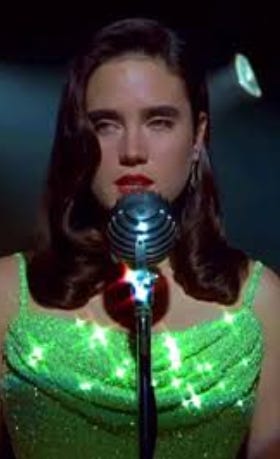
If you’re expecting Emma Murdoch to be a prototype of Trinity from The Matrix, I’m going to have to disappoint you, dear Guests. Mostly, she serves a sort of story GPS for Bumstead, taking him to the places he needs to go to. That sadly leaves her with some of the least character to explore.
In some ways, I’d say that makes sense. She’s a stand-in for the rest of the city’s numbed, manipulated populace. All of them going through their night-to-night life as best they can. All of them hoping for better things that never show. All of them dead inside, never questioning things like John, Bumstead or even Walenski.
With that said, there are three scenes where we get a feel for her character. The first is John’s appearance in their apartment, which wakes up things inside her. When she confronts him with making her worried, his confusion and fear from the amnesia cuts it short.
His confession of being with a call girl to test himself makes her heart go out to him. Indeed, her simple “I believe you” speaks volumes about her feelings. It’s enough to have her help him get away from Bumstead right after. Her love for him means more than doing what’s “right”.
The other key scene to their relationship is at the police station where John is in custody. It is such a special moment that I’ll only say a little about this. Two things, to be exact.
First, Emma gives John the best declaration of true love I have seen in any film. With those words, she declares that her feelings mean more than what the actual facts are. Second, film scenes of lovers separated by jail contain vital foreshadowing. They point to where the relationship is ultimately going to wind up. This end of this scene is no exception.
Oh, wait, I mentioned three scenes, didn’t I? In fact, the last one comes between these two. But to truly appreciate this, we need to approach our last player on the field.
The Pale Shadow
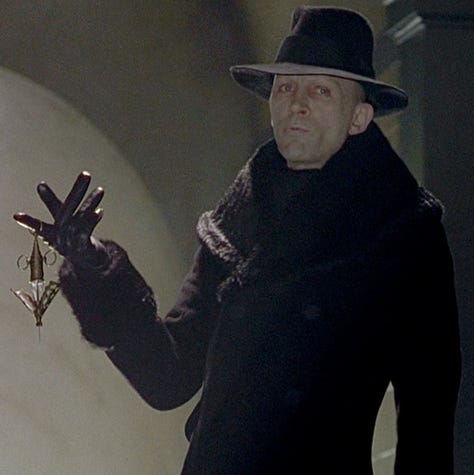
The time has come to formally meet Short Ghoul AKA Mr Hand. In a real way, despite the distinctive goth costuming (heavily inspired by Max Schreck’s vampire in Franz Murnau’s Nosferatu), he’s Agent Smith to John Murdoch’s Neo.
At first glance, he seems a fairly typical member of the Strangers, a telekinetic race with a collective memory that use the pronouns “we” and “our”. His ability to instantly knock out humans with a simple “Sleep now” makes him stand out a little. But his albino skin, dark coat and hat and totally cold affect marks him a charter member.
The first turning point for him is when his sleeping trick doesn’t work on John (the eye blink he gives that moment is quietly epic). Between that and watching John use his Tuning, he grows obsessed. Out of all the humans in this city, why him? What makes him unique enough to do all this?
His questions actually cut to the heart of the Strangers’ dilemma. See, they’re not just running humans through these nightly experiments for kicks. All of them have a definite purpose towards helping them out of a dilemma their long-lived race has no answer for. John’s existence makes them collectively think he may be part of the solution.
This makes Mr Hand come up with an audacious plan. He has Schreber whip up with another copy of John’s memories. When they’re made, he has himself injected with them over the objections of his fellow Strangers. The stated reason is so Mr Hand can better track John down. But I’m fairly certain this had more to do with Mr Hand’s personal curiosity.
The scene between him and Emma points to this. They get philosophical about places and the memories they stir. The Directors Cut gets more explicit about this, having Hand allude to how different his race’s memory and thought processes are. You can feel him drinking in Emma’s reactions like a thirsty man guzzling water. By the time he walks away, he’s certain that he’s learned something important.
But he really hasn’t. In fact, his reasons for this whole plan is flawed AF. As John points out in their final conversation, the only thing Hand winds up learning is how John was supposed to feel. That’s a far cry from the way John wound up feeling. This Stranger started with a flawed premise and never once let the facts actually correct his course.
Small wonder why, in the end, the answers Mr Hand seeks ultimately exceed his grasp. He meets his end as lost as ever. What John could have been was never going to get him to where John actually wound up.
Breaking Of The Dawn
Much like the rest of Dark City, the ending is best experienced with as few spoilers as possible. I will say that daylight breaks, that John finally gets where he wants to go and there’s a bittersweet tinge to the final moments.
And perhaps that is the final lesson of this remarkable film. It’s possible to get the answers in the end. But there will always be a price. Still, dear Guests, the steepness of that price should never dissuade you from paying it. The truth, whatever form it takes, is always better than the lie.
Thankfully, this film is easy to find on streaming (as of this writing, it’s available on Tubi, the Roku Channel and Sling TV for free and all other major platforms for a small fee). But if you truly like it as I do? You owe it to yourself to get the Directors Cut.
But regardless of which version you watch, I do hope that it winds up taking your thinking past this city’s limits.